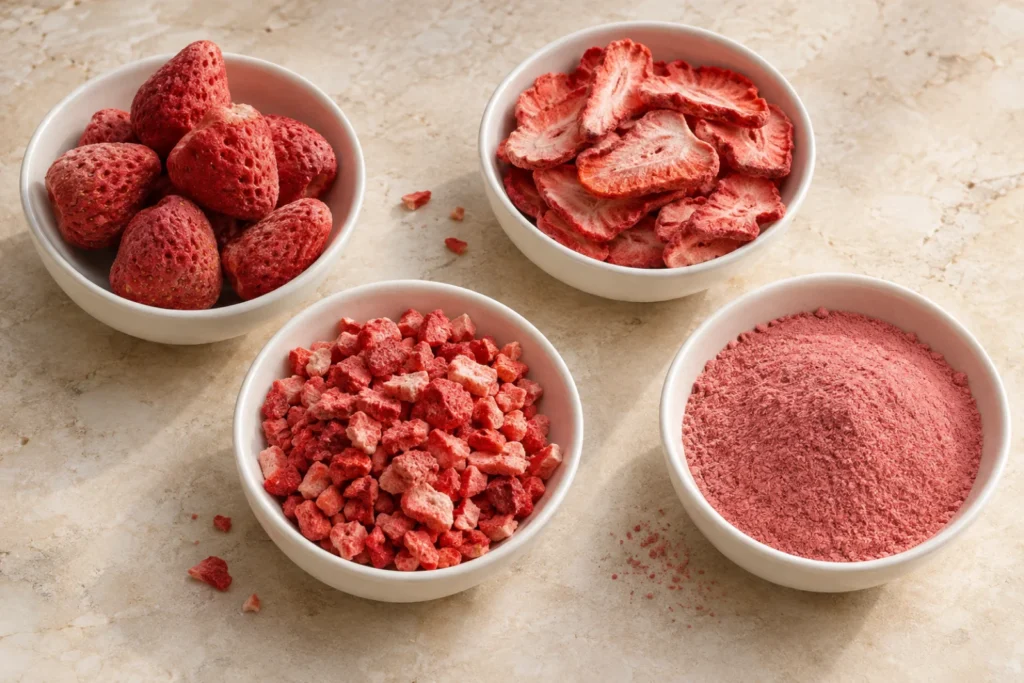
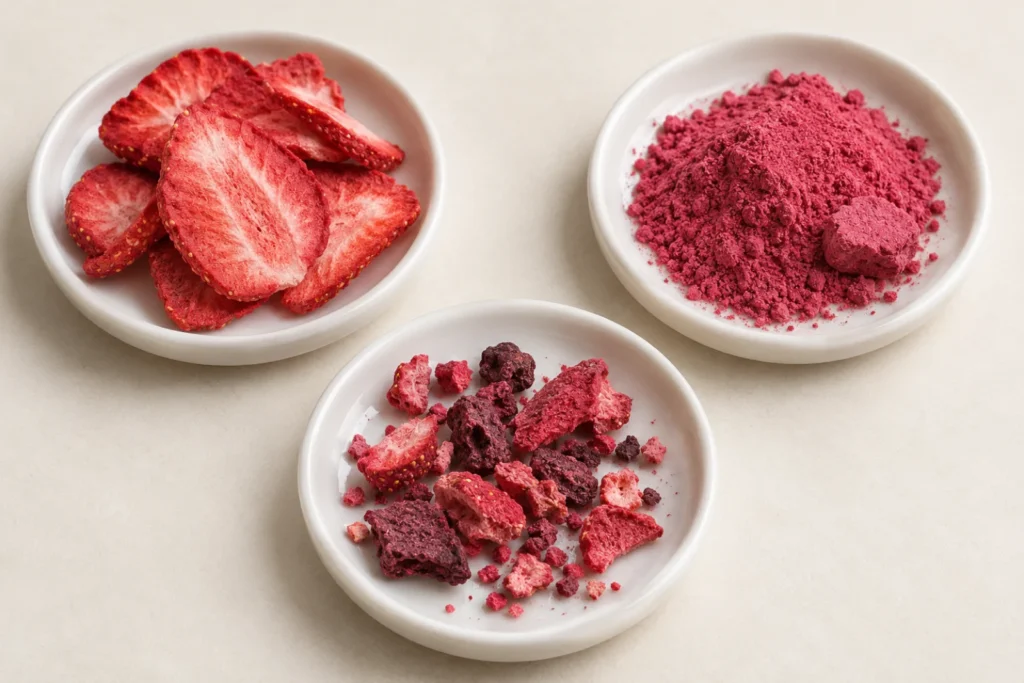
A freeze-dried fruit supplier's document package can contain food safety certificates, product specifications, laboratory reports and registration information. Each answers a different purchasing question. Reviewing them separately helps a buyer establish whether the proposed site and product meet the requirements of a particular project.
Begin with the destination market and the customer's supplier-approval requirements. A collection of logos does not establish the status of the site that will manufacture or pack your order.
Check the site, scope and current status

For any certification, compare the legal entity and site address with the actual production arrangements. Read the scope to establish which activities and products are covered, and check relevant exclusions, dates and status.
BRCGS provides certification information through its Directory, while FSSC maintains a public register of certified organisations. Where access or detail is limited, request clarification from the supplier or certification body. BRCGS Directory, FSSC public register.
A certificate for a trading office, warehouse or related factory should not be assumed to cover a separate manufacturing site. Similarly, an old website image is not sufficient evidence of current certification.
Distinguish the documents buyers commonly receive
BRCGS Food Safety and FSSC 22000 certification concern the applicable food safety arrangements within their stated scopes. They do not replace the buyer's product specification, agreed release criteria or confirmation of destination-market requirements.
HACCP describes an approach to identifying and controlling food safety hazards. Ask what a claim such as “HACCP certified” refers to: the scheme, issuing body, site and scope. Do not assume that every HACCP-based operation must hold a separate third-party HACCP certificate.
Organic certification addresses the applicable organic requirements. Verify coverage of the proposed product and relevant activities before treating it as eligible for an organic claim. Food safety certification and organic status are separate checks.
FDA food facility registration belongs in the regulatory-registration category. It should not be described as a product-quality certificate or FDA approval. FDA food facility registration guidance.
FDA also explains its registration framework and the renewal obligations for facilities required to register. Ask for appropriate confirmation through the supplier's process rather than assuming a registration number can be checked in a public food-facility directory. FDA food facility registration information.
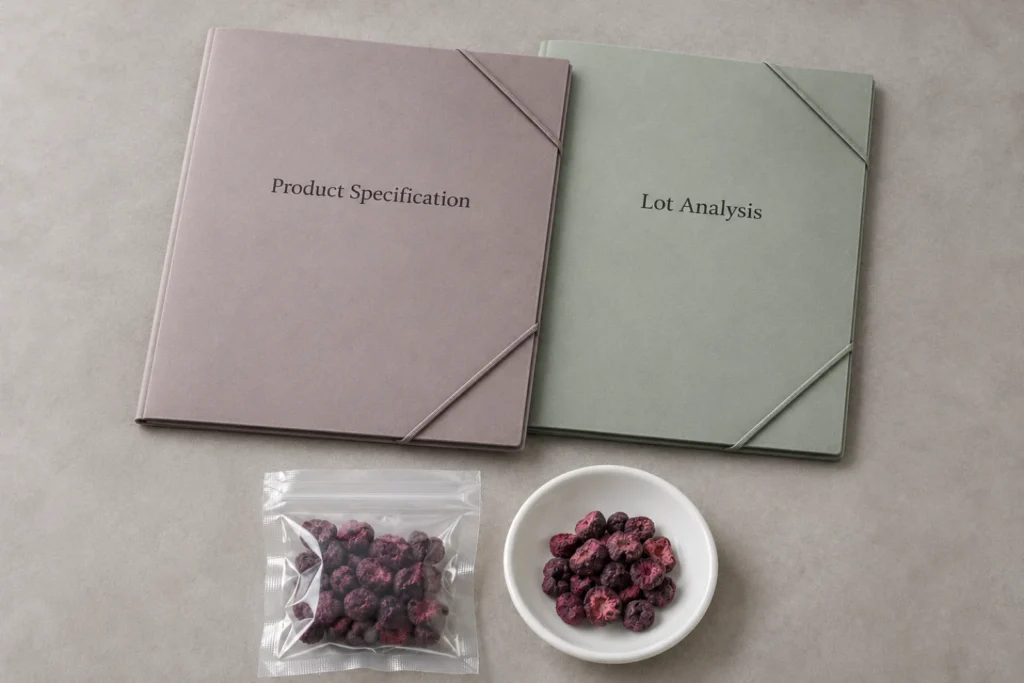
Read a Certificate of Analysis alongside the specification
A specification states the agreed requirements. A Certificate of Analysis, or CoA, reports information about an identified product or lot. Ask which results are measured for the supplied lot and which statements rely on a periodic monitoring programme.
Check the product name, batch identification, sampling information where available, test methods, reporting units and results. A pass statement alone may not answer a question about the actual result or reporting limit. Where a report claims laboratory accreditation, confirm that the relevant testing falls within its scope.
Build a focused document request
For the proposed order, request the documents relevant to the project:
- Current site certification and scope, where required by the customer.
- Product specification and complete ingredient information.
- An explanation of the batch-release and testing programme.
- Appropriate allergen, residue and traceability information.
- Packaging, storage and shelf-life instructions.
- Destination-specific import or claim documentation where applicable.
Agree how updates will be communicated when a certificate, site, formulation or production arrangement changes. This is more useful than repeatedly collecting documents without reviewing what they cover.
Frequently asked questions
Does a certificate guarantee every batch meets our specification?
No. Review the agreed specification and release records as well as the applicable certification.
Must every supplier hold every listed certification?
No. Requirements depend on the customer, product, activity and market. Ask which documents are relevant to your project.
Request documents for a sourcing project
Tell TIANQIN the product, destination and required approval scheme. Ask which current site documents and product records can be provided for the proposed supply arrangement.