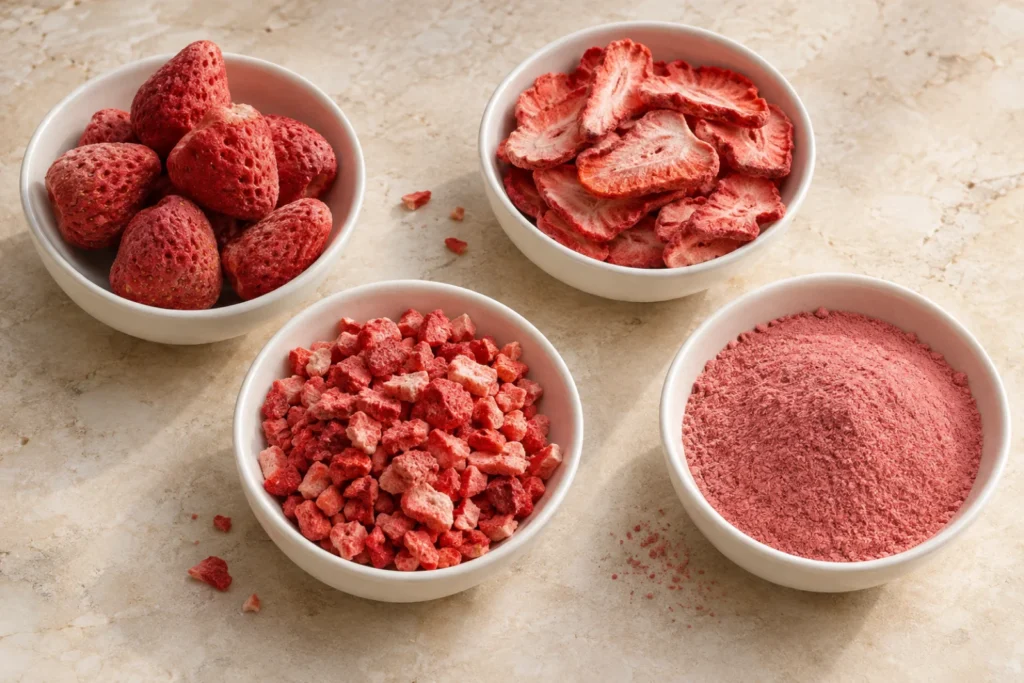
Freeze-dried fruit quotations reflect raw-material cost, processing yield, product specification, packing and delivery terms. Two offers for the same fruit can differ because they describe different products or commercial arrangements.
Understanding these factors helps buyers ask for comparable quotations. It does not provide a reliable forecast of the next market price, so purchasing decisions should use current offers and an agreed specification.
Raw-material supply and usable yield
Crop conditions, variety, origin and competing demand can change the cost of suitable fruit. Availability of fresh fruit does not always mean availability of the size, maturity or grade needed for a particular freeze-dried product.
Water removal also changes the relationship between incoming fruit weight and saleable dried weight. Preparation losses, rejected material and final grading affect usable yield. There is no single fresh-to-dried conversion ratio that accurately prices every fruit and format.
For repeat orders, ask whether a quote reflects a particular crop, origin or inventory lot, and how changes will be communicated.
Cut, grading and additional processing
Whole berries, slices, dice and powder can have different cost structures. Uniform whole fruit may need additional selection, while powder may require milling, sieving and moisture-controlled packing. Neither whole fruit nor powder is always the cheapest option.
Tighter size ranges, fewer broken pieces or a lower permitted fine fraction can reduce the proportion of material that meets the agreed grade. A cheaper quote may allow a broader specification. Confirm that difference before treating it as a saving.
Production, testing and packaging
Freezing, vacuum drying, labour, maintenance and energy contribute to processing cost. Their effect varies by facility, product and scheduling; a change in one cost does not necessarily produce an immediate matching price change.
Small packs can require more packaging and filling work per kilogram than bulk packs. Specific testing, certification-related supply conditions or nonstandard packaging may add cost. Ask which items are included rather than assuming that every supplier offers the same service package.
Delivery terms affect the comparison
Check the currency, order quantity, net weight, freight basis and quote validity. Port-to-port freight and delivered-to-warehouse pricing are different comparisons. Payment terms, import charges where applicable and inland transport can also change the buyer's total cost.
Use one written request for quotation so each supplier responds against the same product and delivery assumptions.
Calculate cost per usable kilogram
Consider an illustrative comparison: an ingredient priced at USD 20/kg with 90% usable yield costs about USD 22.22 per usable kilogram before other costs. One priced at USD 21/kg with 97% usable yield costs about USD 21.65 per usable kilogram. These are example figures, not market quotations; actual yield must come from the buyer's process.
For recipe decisions, also compare the cost per finished serving at an acceptable flavour and appearance. Do not assume that a lower inclusion rate will deliver the same consumer experience without a trial.
Manage price exposure through planning
Share forecasts and discuss ordering windows, scheduled releases and alternative formats that still satisfy the recipe. Longer agreements can make planning easier, but fixed prices, volume commitments and adjustment clauses must be negotiated. A contract does not remove crop, quality or delivery risk.
Frequently asked questions
Is harvest season always the cheapest time to order?
No. Crop quality, existing inventory, demand and processing capacity also matter. Ask for a current quotation and its assumptions.
Should a lower-price specification be accepted?
Only after checking its effect on usable yield, processing and finished-product quality. An acceptable change is one supported by testing and a revised specification.
Request a comparable quotation
Provide TIANQIN with the fruit, format, quantity, target market, packing and delivery destination. Ask for the quote's validity and inclusions so it can be compared on a consistent basis.